You won't know August was empty until October.
The branch tier puts one daily standard in every seat, gives you a manager view of who is actually holding it, and turns the weekly one-on-one into a conversation that opens with a number instead of a guess.
A branch goes quiet before it goes down.
No branch fails on a Tuesday. It goes quiet one uncounted week at a time — a producer who stops making partner calls in March, another who quietly trades prospecting for file work, and a third who is busy every day with nothing that creates a next month.
None of that shows up in a pipeline report, because a pipeline report only knows about work that already happened. By the time the funded number tells you something is wrong, the activity that caused it is ninety days gone. You can't coach a quarter you can no longer see.
So the meeting becomes a review of loans in process and a round of "how's it going." Everyone answers honestly, everyone says busy, and busy is not a number.
Most branches manage the lagging indicator and call it management. Drift at the branch level is the same thing it is for a person — nobody decided on it, and nobody can see it while it's happening.
"You are not behind because the market turned. You are behind because eleven weeks went uncounted."
One screen, every seat, this week.
The manager view is a roster, not a report you request. It is current as of the last time each person logged, which is the point — a blank card is information.
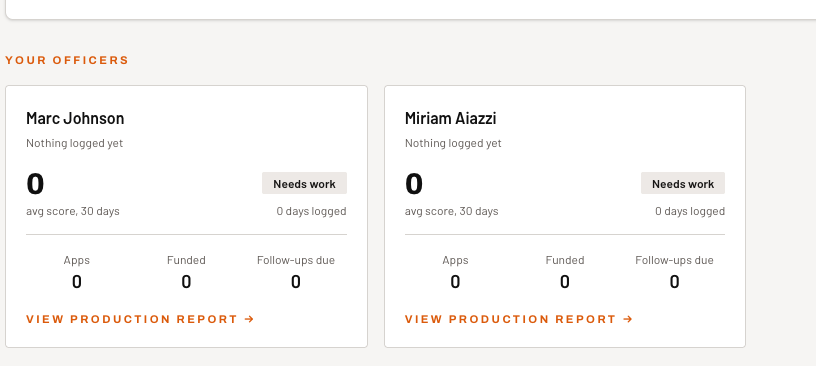
The roster
Every officer on one screen, in one list. Anyone who hasn't logged shows as nothing logged yet — no digging required to find the quiet seat.
A score per person
A 30-day average score for each officer, with a plain-language status beside it, so you can read the whole branch in about ten seconds.
Days logged
How many days that person actually logged in the window. A low score and no logging are two different problems, and this separates them.
Apps, funded, follow-ups due
Three numbers per officer: applications, funded loans, and follow-ups currently due — the work created, the work closed, and the work being dropped.
The production report
Open any officer's full production report from their card when a number needs explaining, instead of asking them to assemble one for you.
The meeting changes when it opens with a number.
"How's it going" gets you an honest guess. The officer describes a week from memory, you weigh it against your impression of them, and you both leave with a feeling about a business that runs on counts.
When the same meeting starts from a score both of you already saw on Monday, there is nothing to establish. Nobody is defending effort. You spend the time on the one behavior that moved the number down and what tomorrow looks like instead.
It also stops the conversation you dread — the one in October about a quarter that was already over in July. Eleven weeks of gap becomes one week of gap, and one week is coachable.
Without it
"Pretty good week." A guess, a nod, and no idea until the funded number arrives.
With it
"Four logged days, partner calls at half. Let's fix Thursday." Same fifteen minutes, different meeting.
What it isn't.
It isn't a CRM and it isn't an LOS. Keep both. Those tools track loans; this tracks the activity that creates them. It isn't a lead source either — VYKON doesn't produce business, it makes sure your team does the work that produces business.
And it isn't surveillance. It tracks the daily activity each person already agreed to — partner conversations, consultations, calls, annual reviews — nothing about location, keystrokes, or hours at a desk.
The order matters: the officer sees their own numbers first, on their own dashboard, for their own plan. Your view is the same numbers rolled up. Nobody learns their score from you in a meeting.
That's also the honest answer to adoption. A tool the team resents doesn't get used, and an unused tracker is worse than none because the blanks look like failure. Logging a day takes under two minutes, and what the officer gets back — their score, their rolling ninety days, their coach — is worth more to them than to you.
Set up on one call. Useful in two weeks.
There is no implementation project and nothing to install. Here is exactly what happens.
A setup call with you
We get on a video call together and set the branch up live — your standard, your seats, and your manager view. You leave the call with a working account, not a login and a help article.
Invitations go out on that call
Every loan officer is invited during the session, so nothing waits on you to send emails later. Each person sets a password and writes their plan on first login.
Day one: who's in
As officers log for the first time, cards fill in. Within the first few days you can already see who started and who hasn't — the adoption problem shows up immediately, not in month two.
Week two: a real signal
About two weeks of logging is enough to read a person's pattern instead of their week. At thirty days the average score is stable and the rolling ninety-day view is doing its job.
What managers ask first.
No. Keep it. Your CRM tracks the loan; VYKON tracks the activity that creates loans. They do different jobs and don't compete.
Both. The manager view lists every officer with their 30-day average score, days logged, and applications, funded, and follow-ups due, and you can open any person's full production report.
No. An officer sees their own plan and their own numbers. The roster view of the whole team is yours.
You remove their seat and the seat is free for the next hire. Their personal plan belongs to them; the branch keeps its own production history.
No. It's month to month. No setup fee on Loan Officer, Branch or Coaching Company, cancel anytime.
The Branch plan is $399 a month and includes 10 users. If you're running more than 10 officers, the price depends on how many seats and how you're structured — book a walkthrough and we'll size it on the call. Larger operations usually land on the Coaching Company plan, which includes 50 active users.
Yes, and many managers do. Start with the people who'll actually log, let their numbers speak for a month, then invite the rest. You only invite the seats you want.
Reading the roster takes a couple of minutes. The work is in the one-on-ones you're already having — they just start from a number now.
You'll know in the first week instead of the first quarter, which is the point. Logging a day takes under two minutes, and the officer gets their own score and coach out of it.
One price for the branch.
Or $3,990 a year — two months free.
10 users included, plus the manager view of the whole team, printable coaching reports, the recruiting pipeline, and weekly recap emails. No setup fee on Loan Officer, Branch or Coaching Company. Cancel anytime.
More than 10 officers? Book a walkthrough and we'll size it.
Count the week, or explain the quarter.
You will find out how this quarter went either way. The only question is whether you find out while you can still do something about it.
A standard nobody can see isn't a standard. Make it visible this week, and the October conversation stops being a surprise.