Every producer I know has had this month.
You open the pipeline and it's thinner than it should be. So you start diagnosing October. The market. The rates. The referral partner who went quiet. Something about right now that explains the number in front of you.
But October wasn't decided in October.
Activity leads results by about ninety days. The conversations you had in July became the applications you're looking at now. Which means the scoreboard on your screen isn't a report on how you're doing.
It's a report on the person you were a quarter ago.
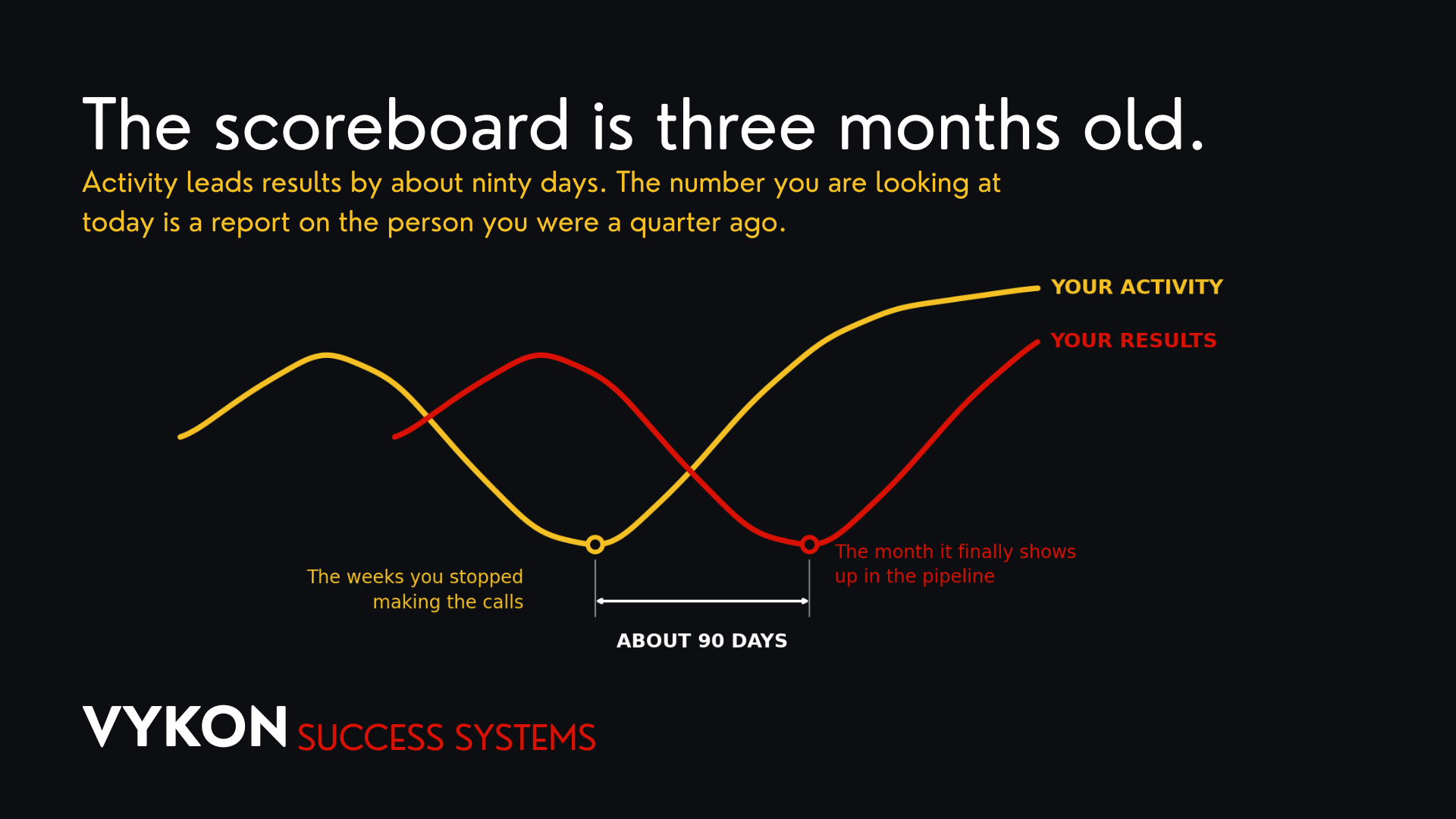
That one fact changes almost everything about how you should read your own numbers.
It means a bad month can't be fixed in the month it shows up. By the time you see it, the cause is ninety days behind you and out of reach. You can work twice as hard starting Monday and October will still be October. What you're actually fixing is January.
It also means a good month is not evidence that you're doing the work today. Plenty of people have coasted through a strong quarter that was earned by a version of themselves who'd already stopped showing up. The results were still arriving from behind. Nothing felt wrong yet.
That's the part that ought to bother us.
Drift never announces itself.
It doesn't show up as a decision or a bad week. It shows up as a series of reasonable weeks where the standard gets renegotiated by an inch — one call rescheduled, one conversation skipped because the day got away from you, one partner you'll circle back to when things settle down.
None of it looks like anything at the time. The numbers still look fine, because the numbers are three months behind. And by the time they catch up, we've forgotten what we didn't do.
An entire industry lived through this between 2020 and 2022. When the phones rang on their own, a lot of us quietly stopped doing the things that made them ring. The scoreboard kept saying we were fine. Then the market turned, and the bill arrived addressed to people who couldn't remember ordering anything.
So what do you do with a number that's always late?
You stop managing the result and start managing the input.
The result is a lagging indicator, and you cannot control it today. But the activity that produces it is happening right now, and it's completely within your control. Six partner conversations. One consultation. Six lead and client calls. One annual review. On a good day that's routine. On a Thursday in a slow market, after two declines and a file that fell apart, the sixth partner call is genuinely heavy — and that call is the rep that counts.
Here's the thing nobody says out loud. Most of us aren't tracking any of it. We know roughly how the month went. We could not tell you how many conversations we had last Tuesday.
Which means we're carrying our own performance in memory, and memory is generous. It keeps the busy days and loses the empty ones.
You can't drift if you're counting. Not because counting is magic, but because drift depends on nobody noticing, and a number you write down every day removes the place it hides.